October 21, 2026
Resources
The internal language was worse: something is fundamentally wrong with me.
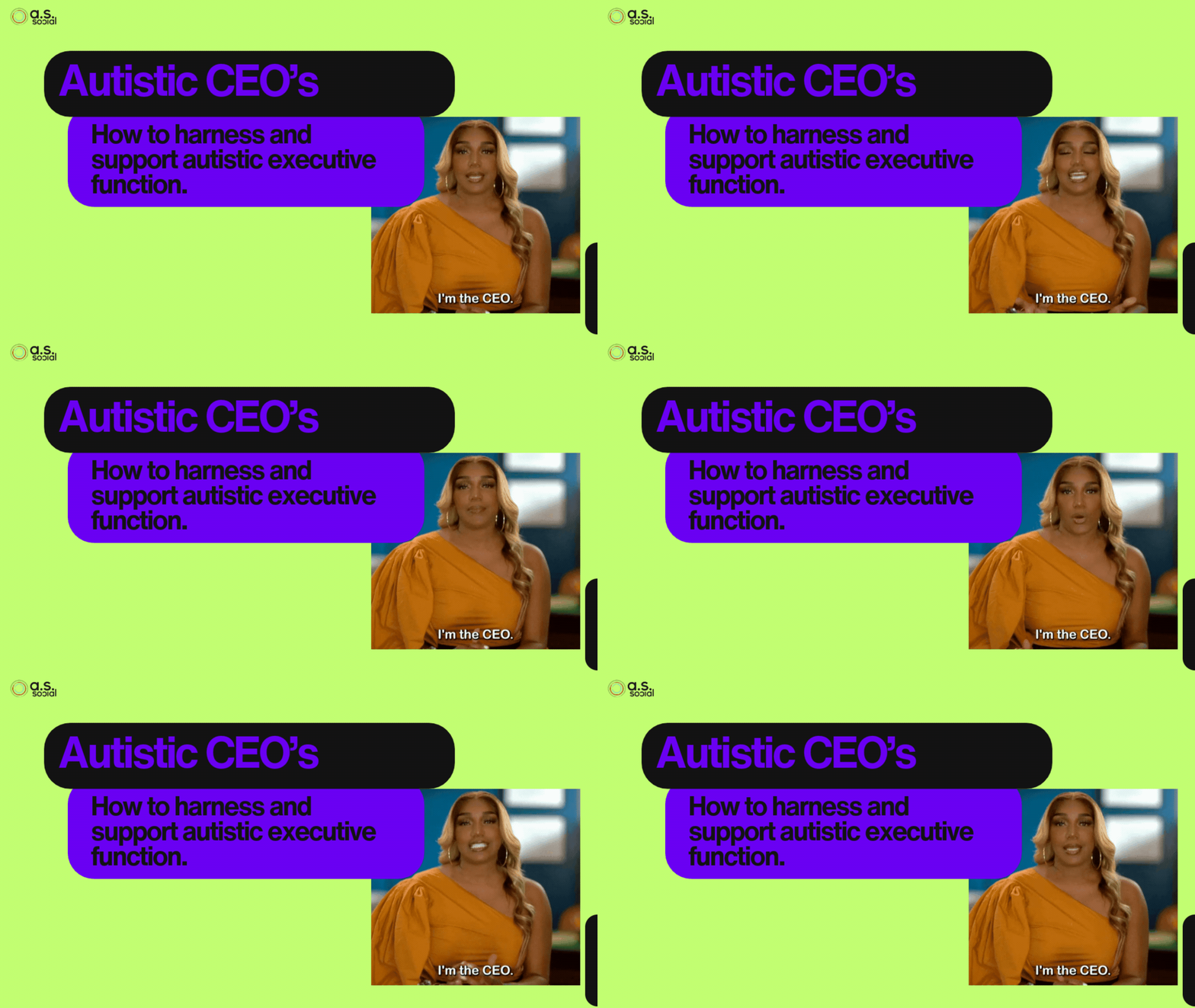
They're the head of a vast, complex, endlessly demanding organisation. They manage logistics, communications, resource allocation, crisis response, quality control, and long-term strategy — often simultaneously, often under-resourced, often without so much as an administrative assistant.
They are the first to be blamed when something goes wrong. They are the last to be praised when something goes right. They are expected to function flawlessly in a building that's on fire, with a board of directors who've never done the job and don't understand the industry, and a workforce that's running on fumes.
This is my CEO.
They're the Chief Executive Officer of my life. They run the show. And for most of my life, I've been told they're incompetent.
I was disorganised. Forgetful. Couldn't start tasks. Couldn't stop tasks. Lost track of time. Missed deadlines. Struggled to sequence steps. Couldn't "just do the thing" that everyone else seemed to do effortlessly.
The clinical language was "deficits in executive functioning." The casual language was "why can't you just..." The internal language was worse: something is fundamentally wrong with me. Everyone else can do this. What's broken in my brain?
But here's what nobody told me:
And the conditions I was living in were, to put it mildly, hostile.
Before we talk about support, we need to talk about depletion. Because you can't build capacity while you're haemorrhaging it.
This is the big one. Autistic burnout is not "being tired." It's a state of profound depletion that affects every cognitive process, including executive function. When you're burned out, the CEO is running on no sleep, no food, and twelve back-to-back crisis meetings. Of course they're dropping balls. They're surviving.
Every hour of masking is an hour of cognitive labour taken away from planning, organising, and executing. You are asking the CEO to run the business *and* perform a full-time theatre production in the lobby simultaneously. No wonder the strategy is suffering.
When your nervous system is processing fluorescent lights, background noise, uncomfortable clothing, and unpredictable sounds, there is no cognitive capacity left for deciding what to have for dinner. The CEO is not lazy. They're firefighting.
Executive function is notoriously fragile during trauma responses and periods of acute stress. This is not weakness. It's biology. The brain prioritises survival over scheduling.
Paradoxically, growth itself can temporarily deplete executive function. Learning new skills, expanding capacity, going through transition — all of it temporarily taxes the system. The CEO is not failing. She's rebuilding the building while living in it.
The point
Executive function deficits are often not about absence. They're about depletion. And depletion is a context problem, not a character flaw.
Here's what the clinical literature spends far less time on: **what actually makes executive function better. Not "how do we train the autistic person to be more organised." But "what conditions allow an autistic person's executive function to operate at full capacity?" The answer is not more willpower. It's not a new planner app. It's not waking up at 5am.
And regulation comes from two places that nobody talks about in the context of executive function: sensory awareness and social connection.
You cannot manage a business while the building is on fire. The most effective executive function support is not a productivity system. It's a sensory system that doesn't drain you before the day begins. When you are sensory-regulated — when the environment isn't actively assaulting your nervous system — you have capacity. When you have capacity, you can plan. You can initiate. You can execute.
This means:
Knowing your sensory profile — what regulates you and what depletes you
Designing your environment — headphones, lighting, temperature, texture, noise
Scheduling sensory breaks — not as reward, but as infrastructure maintenance
Tracking your sensory load — anticipating depletion before it happens
When the sensory infrastructure is in place, executive function has space to operate. When it isn't, the CEO spends all day putting out fires and has nothing left for strategy.
The sensory plan is the business plan.
Here's something even less discussed: positive social interaction supports executive function. This is not intuitive. Most people assume social and executive are separate. They're not.
The research on autistic-autistic connection shows that when autistic people are with their neurokin, cognitive load decreases significantly. The effort that usually goes into masking, translation, and social performance evaporates. And that freed-up capacity doesn't just improve the social experience — it improves everything.
I've noticed this in my own life. When I've had a genuinely good conversation with someone who gets it — no performance, no translation, no masking tax — I suddenly have the capacity to do the dishes. To write the email. To make the appointment. To do the things that have been sitting on my to-do list for weeks, paralysed by some invisible barrier.
The good conversation didn't just feel nice. It refilled the tank the CEO draws from.
This is because executive function is not a discrete organ. It's a process that operates on top of everything else. When your nervous system is settled, your social needs are met, and your energy is not being drained by masking and translation, the executive function has a foundation. When it isn't, the CEO is trying to plan the year while the building is on fire and the board is screaming and no one has brought them so much as a glass of water. You cannot separate executive function from the rest of the self. The CEO needs infrastructure, a staff, and a safe building to run the organisation.
So what actually helps? Here's what I've learned — and what the research supports.
Do not start the day by immediately asking the CEO to solve problems, make decisions, and execute tasks. Give them a transition period.
What it looks like:
- A slow morning that includes something regulating — not a phone.
- 20 minutes of quiet before the day begins.
- A sensory-friendly start to the day — soft light, comfortable clothes, predictability.
- The first task is not the hardest task. Warm up.
Why it works: The CEO needs to be nourished before they can lead. Not fuelled by caffeine and panic.
Build a sensory operating system you can rely on.
What it looks like:
- Know your three biggest sensory drains and your three biggest regulators.
- Have your regulators within arm's reach at all times. Headphones. Sunglasses. Fidget. A specific song.
- Schedule recovery time between tasks that drain you. Not at the end of the day. Between tasks.
- Say no to environments you know will cost you more than you can afford.
Why it works: You can't build executive function while your nervous system is fighting for survival. Sensory regulation is the foundation.
The CEO's working memory is not infinite. Stop making them hold it all in their head.
What it looks like:
- One calendar. One task list. One notes app. Not five.
- Write it down immediately. Don't trust the internal filing system.
- Use alarms and reminders for transitions and deadlines.
- Make the invisible visible. If you can't see it, you'll forget it exists. This is not a flaw. It's the nature of the CEO's memory system.
Why it works: Externalising cognitive load reduces the burden on the CEO, freeing them up to focus on strategy rather than administration.
This is the one nobody talks about.
What it looks like:
- Plan time with your neurokin *before* tackling a big task. The social connection is not a distraction. It's refuelling.
- If you're struggling with task initiation, try co-working. The presence of another person can make the task feel possible.
- Seek out people who don't cost you energy. Every conversation should not be a performance.
- Use body doubling. Sometimes the CEO just needs someone else in the building.
Why it works: Positive social interaction reduces cognitive load and replenishes capacity. The right person makes the task possible.
Here's what I wish someone had told me years ago.
What it looks like:
- Not forcing the "normal" pace. Not trying to match the neurotypical productivity schedule.
- Letting the task take as long as it takes.
- Not scheduling every hour of the day.
- Building in buffer time, recovery time, and unscheduled time.
Why it works: Your CEO is not running the same business as everyone else. They're running yours* And they're allowed to do it their way.
When the CEO collapses — and they will — they don't need a lecture. They need a reset.
What it looks like:
- When you're not functioning, don't fight it. Do the smallest possible version of something that matters, and let the rest go.
- Give yourself permission to have a bad day without adding shame to the pile.
- Know your reset protocol: the specific things that replenish you, and the specific people who help.
- Forgive the CEO. They are doing their best with the resources they have.
Why it works: Shame is another tax on a depleted system. The CEO needs support, not critique.
You don't need to become more organised. You don't need to force yourself into a neurotypical productivity system. You don't need to "just focus." You need infrastructure. You need regulation. You need the right people around you. You need permission to work at your own pace. And you need someone to tell you that your CEO is doing a good job.
So here I am, telling you.
Your CEO isn't a failure. They're a survivor. And They deserve a better board of directors.
The good news is — your CEO can fire them.
A.S. Social: Actually Solving Shit. Since 2019. ✨
P.S. If your CEO needs a new executive team, we're building one. Join the community. Find your neurokin. Stop trying to run the company alone.